
In the final year of the United Nations Development Assistance Framework (UNDAF) implementation, the
United Nations (UN) in Cabo Verde consisted of a total of fifteen agencies. In pursuit of delineating available and requisite capacities and resources required for meeting the objectives of the new United Nations Sustainable Development Cooperation Framework (UNCF) 2023-2027, a comprehensive assessment was conducted, resulting in the integration of new UN entities, thus achieving a more extensive range of expertise and UN capabilities.
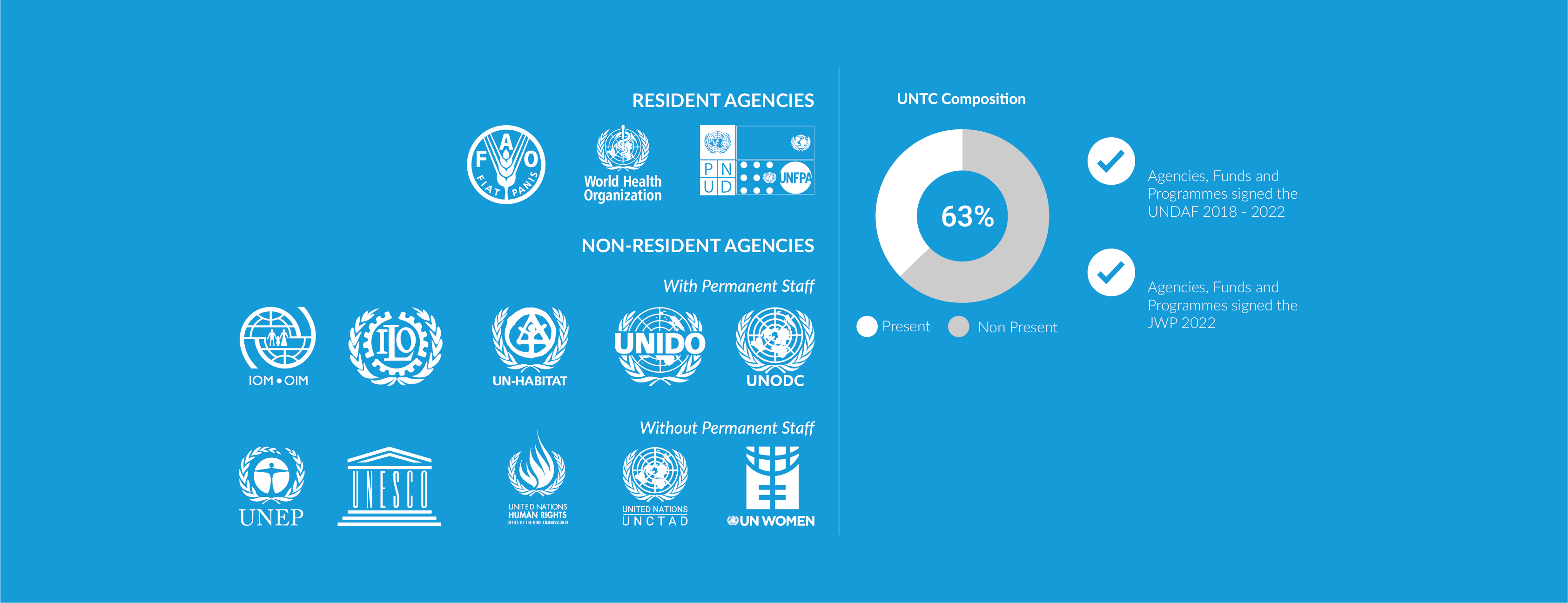
Following the adoption of the new UNCF, the United Nations Country Team (UNCT) in Cabo Verde currently comprises nineteen UN agencies, funds, and programmes.
The UN Resident Coordinator, the appointed representative of the UN Secretary-General for developmental operations, presides over this array of agencies. There are five resident agencies: FAO, WHO and the three Joint Office agencies established in 2006: UNDP, UNFPA, and UNICEF. Five non-resident agencies with permanent staff, comprising ILO, IOM, UNODC, UNIDO, and UN-HABITAT complete the current composition. Additionally, ITU, UNECA, and WIPO have also joined the cluster of non-resident agencies with non-resident staff in Cabo Verde, which includes UNCTAD, UNEP, UNESCO, UN Women and OHCHR.
Most non-resident agencies have an extended technical representation and engagement in the UNCT, while their membership is located regionally, with limited resources available. Technical presence is usually represented by national agency coordinators, project managers, or consultants.
Based on a strategic alliance developed through the UNDAF 2018-2022, the World Bank was a permanent guest in the UNCT, and they also signed the new UNCF, the second country in Africa to achieve it.
The inclusion of new UN entities and their greater range of capabilities and expertise is evidence of the UN’s commitment to facilitating development efforts in Cabo Verde through the UNCF 2023-2027.
DID YOU KNOW?
Cabo Verde was the first and, to date, the only country in the world to establish a Joint Office of UNDP, UNICEF and UNFPA to reduce the overall costs of a UN presence, especially in Small Island Developing State (SIDS) countries.