
Highlights of the 2022 programmatic results achieved per strategic priority (pillar) and financial overview - PLANET

Programmatic Results:
Agriculture and Forestry

The forestry legal framework was reviewed, and an implementation base study and conservation action plan were developed, involving the Civil Society Organizations of Santiago, São Vicente, Maio, and Santo Antão. Plans were approved for guidance on three islands and six forest management plans for six forest perimeters. Moreover, 40 hectares of land were cleared of invasive species in the Ribeira de Rabil, and the vivarium was rehabilitated to facilitate reforestation. In addition, technical experts in the field of the environment (37% women), were trained in precision agriculture and reforestation using drones.
Risk Management, Climate Change, and Meteorology
The theme of climate change was integrated into basic and secondary education, as well as into sectoral plans, strategies, and policies. The country’s national capacity was reinforced in the matter of greenhouse gas inventories, and the evaluation of the impacts of climate change on fisheries, aquaculture, tourism, and energy was conducted. Base documents for the 4th national communication on climate change and the biennial report of the UNFCC were also elaborated. Fourteen meteorological stations were installed, reinforcing the country’s capabilities in data collection and meteorological data processing. Furthermore, the 3rd Seminar of the Lusophone Center on Climate Change was held to implement the Paris Agreement’s Rulebook and decisions adopted in Glasgow.
Water and Alternative Energies
Through the use of renewable energy, 59,200 people (51% women) from Santo Antão, Sal, Boa Vista, and Santiago benefited from greater access to water (4,000 m3/day) and a reduction in the cost (-5%), avoiding 394 tCO2e/ yr. Additionally, 22 farmers (20% men) from Cidade Velha benefited from a solar-powered water pumping system (11.7 Kwp) and a rehabilitated 100 m3 reservoir.
Protected Areas and Watersheds
The capacity of over 100 people (49% women) in conservation and management of coastal and marine zones, monitoring of protected marine and terrestrial areas were reinforced, as well as the capacity for the establishment of an Ecohidrology Demonstration Site in the Maio Biosphere Reserve. Additionally, a Geoportal was created for monitoring of protected areas, and instruments for the management of eight protected areas in Santiago, Sal, Boavista, and Maio (totaling 7,520.8 ha terrestrial and 28,418.8 ha marine) were submitted for official approval.
Tourism and Housing
In the tourism sector, ten certified sustainable tourist accommodations were established with

the IGQPI, and three Decrees-Laws were approved (nº 43, 44 and 45/2022). In housing, 600 households in Água Funda (Praia) benefited from a new Community Center for training programmes, child education services, and associative development.
Political and Public Dialogue
A national environmental platform was created to be managed by the Marine Turtle Conservation Network (TAOLA+). The Observation of Marine Turtles and nesting beaches was regulated.
Planet Pillar – Financial Overview
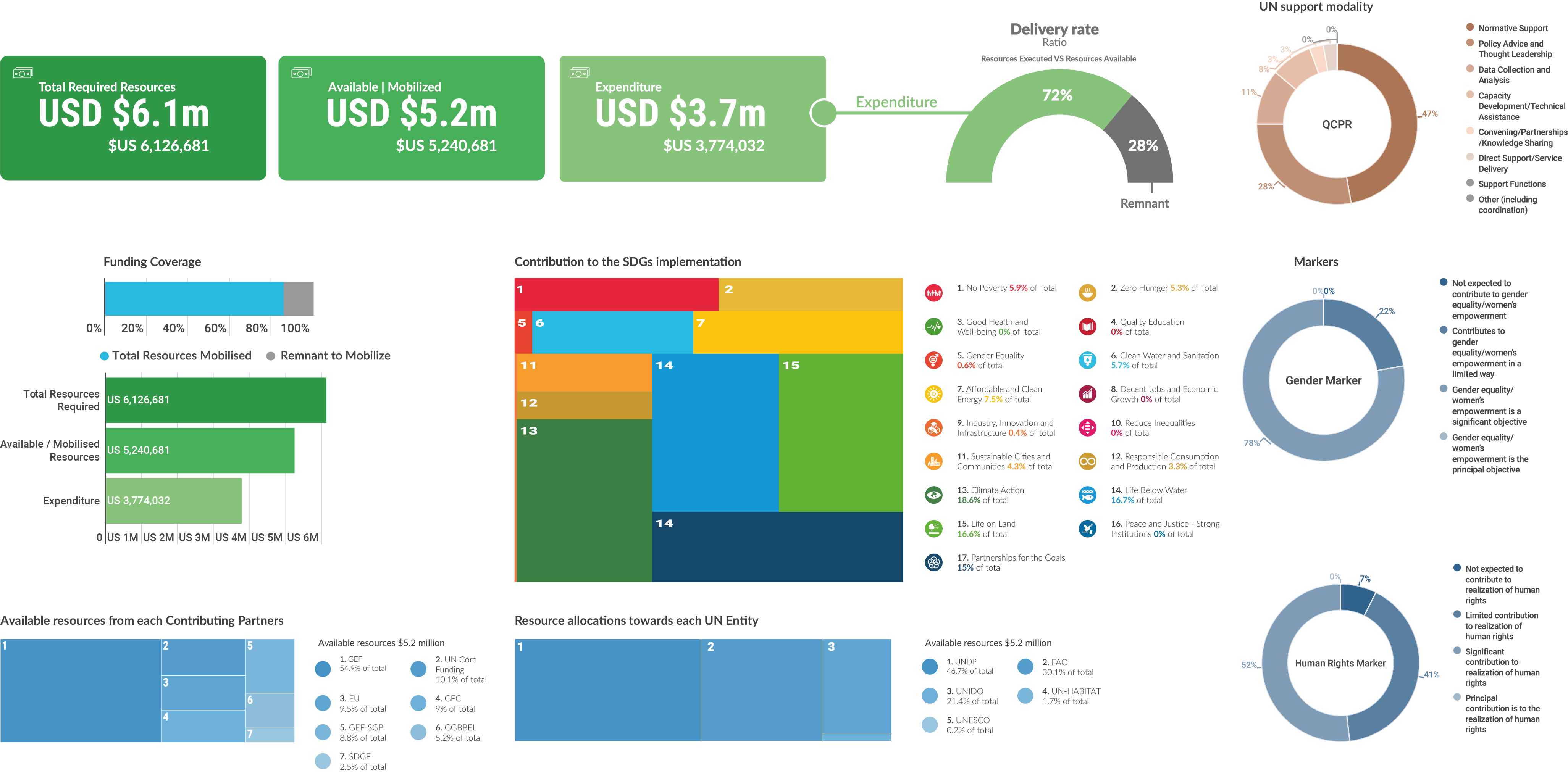
The Planet Pillar received the largest share among the five pillars, with a total of US$5.2 million, representing 25.8% of the total available funds. This amount covered 85.4% of the required funds for the Planet Pillar, with an implementation rate of 72%.
Among the available funds, the highest percentage, 18.6%, was allocated to advancing SDG 13 in Cabo Verde, followed by SDG 14 and SDG 15, with shares of 16.7% and 16.6%, respectively. The Global Environment Facility (GEF) was the primary financial contributor, providing 54.9% of the funds, followed by UN Core Funds (10.1%), the European Union (9.5%), the Green Climate Fund (9%), the GEF Small Grants Programme (8.8%), the Government of Belgium (5.2%), and the Joint SDG Fund (2.5%).
people (51% women) from Santo Antão, Sal, Boa Vista, and Santiago benefited from greater access to water (4,000 m3/day) and a reduction in the cost (-5%), avoiding 394 tCO2e/ yr.
households in Água Funda (Praia) benefited from a new Community Center for training programmes, child education services, and associative development
people (49% women) in conservation and management of coastal and marine zones, monitoring of protected marine and terrestrial areas were reinforced, as well as the capacity for the establishment of an Ecohidrology Demonstration Site in the Maio Biosphere Reserve