
Highlights of the 2022 programmatic results achieved per strategic priority (pillar) and financial overview - PARTNERSHIP

Programmatic Results:
Coordination and Advocacy
The UN fostered technical coordination and advocacy capacities of the country by:
- Developing and strengthening dialogue platforms with national and local entities, civil society, and international partners as part of the process of formulating the new PEDS II, the extreme poverty eradication’s strategy, of enhancing a broad partnership for achieving the objective of Leave No One Behind (LNOB) among ministries, national institutions, local Government, CSOs, and CBOs providing key inputs for the PEDS II building process, and by building the new UNCF 2023-2027.
- Supporting Cabo Verde’s participation and partnering in the SIDS network to coordinate and build a MVI to facilitate access to concessional finance for SIDS countries and convening AIS-SIDS countries to have a stronger voice in the international arena. As a result, Cabo Verde was selected to host the AIS-SIDS regional conference in preparation for the 4th International Conference of SIDS (SIDS Summit) in 2024 in Barbados.
- Continuing at the local level, the creation and scale up of partnerships for localizing the SDGs between municipalities, NGOs, private sector, and deconcentrated state institutions to enable local institutions to continue responding to the people most affected by COVID-19 and pursuing recovery. The capacity of the Government was enhanced as well as employers’ and workers’ organizations, and social dialogue institutions to mobilize the potential of large businesses (MNEs) to contribute to the achievement of Decent Work for All (SDG 8)
Resource Mobilization
The country’s technical capacity to mobilize technical and financial resources was strengthened, mobilizing resources from:
- Existing partnerships with vertical funds: The Joint SDG Fund, the GEF, the GCF and the UNTFHS.
- The private sector: in partnership with the Cabo Verde Stock Exchange a sustainable finance platform (Blu-X) was launched and implemented in capital markets raising over USD 26 million to finance National Sustainable Development Initiatives.
- A strategic partnership enhanced between the UN and the WB for producing joint analysis, policy recommendations and programme coordination and synergies and UNECA on debt restructuring.
- Four additional specialized UN Agencies – ITU, UNECA, WFP and WIPO – with sound and extensive experience in the new UNCF 2023-27 priority areas joined the UNCT and signed the UNCF to contribute to the new PEDS II.
South-South and Triangular Cooperation
The UN fostered institutional capacity of the Ministry of Foreign Affairs and Communities for South-South and SIDS cooperation. The management, gender mainstreaming and fighting corruption’s capacities of 250 staff of Court of Auditors, Parliaments, Ministries of Finance and non-state actors from African countries. The judicial cooperation in terms of justice, security, criminal investigation, crime and drugs were reinforced thanks to the exchange of experience and cooperation between peers from senior staff from national authorities of African, Latin America and Europe countries.
Partnership Pillar – Financial Overview
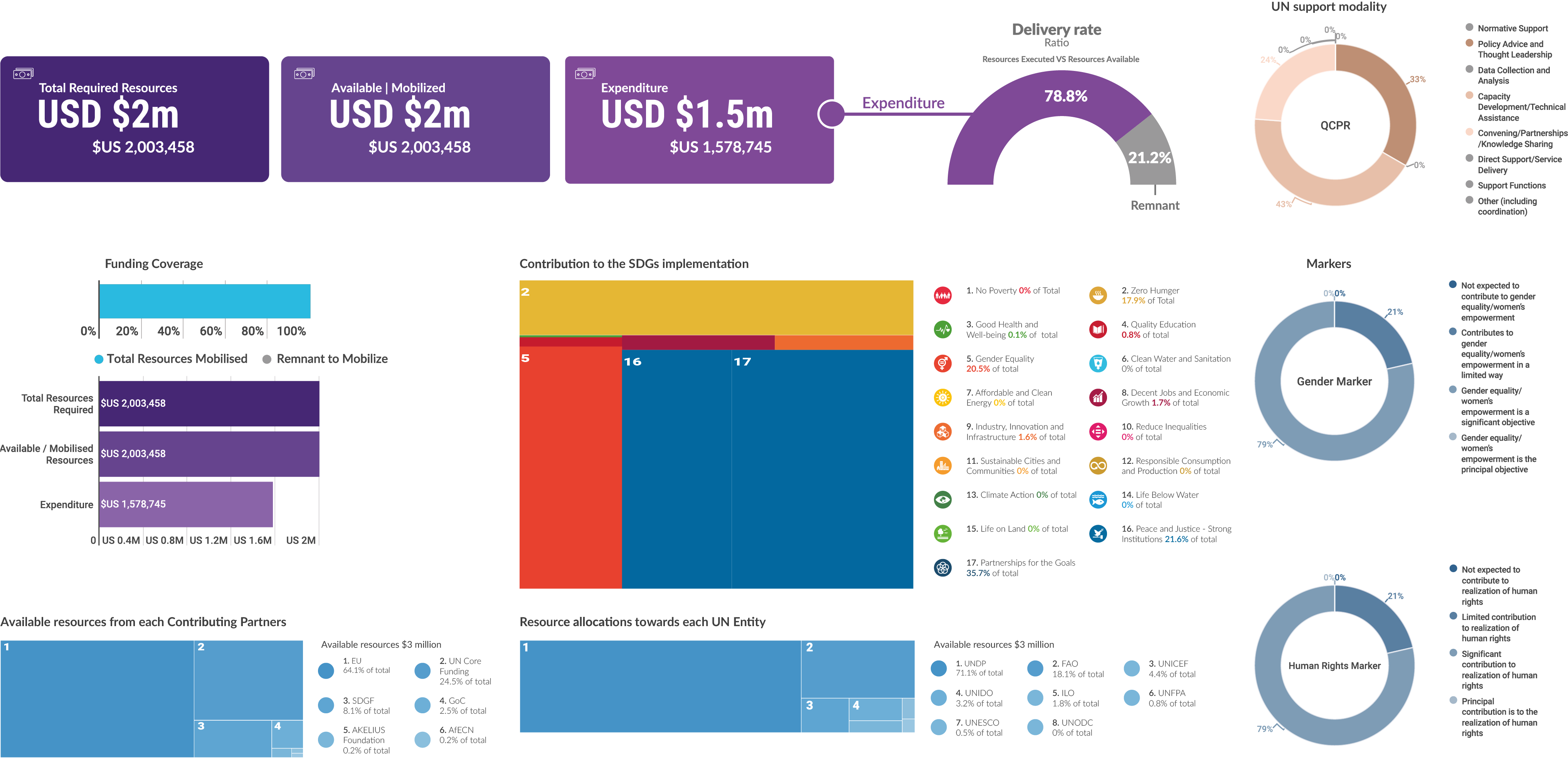
The Partnership Pillar was allocated a budget of US$2 million, representing 9,9% of the total available funds. This amount covered 100% of the required budget for the pillar, with an implementation rate of 78,8%. Among the available funds, just over one third representing 35.7% was allocated to advancing SDG 17 in Cabo Verde, followed by SDG 16 and SDG 5, with shares of 21.6% and 20,5%, respectively. The European Union were primary financial contributor, representing almost two thirds of the funds with 64.1% contribution. The UN Core Funds Union followed with 24.5%, followed by the Joint SDG Fund (8.1%), the Government China (2,5%), Akelius Foundation (0,2%) and AfECN (0.2%).