

“Pursuing My Dream with Inclusive Education”

Livia (left), an 18-year-old high school student with deafblindness, dreams of becoming a Chef once she completes her studies at “Pedro Gomes” public high school. Despite facing challenges, she feels included in her school thanks to various resources, including interpreters and supportive teachers. “In the classroom, the teachers help me a lot, there are interpreters who translate what the teachers speak, I participate in group work, I do my individual work,” says Livia. “But, of course, I recognize that even with these advances, there are challenges. For example, we need more translators in all the classes!”

Similarly, Drica (right), a 15-year-old blind student, is able to attend classes alongside her peers and dreams of pursuing a profession as an adult. She notes that with some materials, such as computers with programmes adapted for the blind, she can fully participate in technology and information classes.
To support effective inclusion of students with special needs, the United Nations through UNICEF worked with the Government in 2022 to implement a signalling system, multidisciplinary teams, and teacher training. This has had a direct impact on students’ school lives, including those with disabilities, as teachers are better equipped to support them in the classroom. With inclusive education and resources, Livia and Drica can pursue their deams and contribute to their communities in meaningful ways.
“I want to end gender inequality in ICT and raise digital literacy”
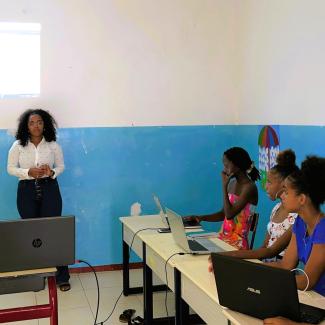
Helena Moreira, 15 years old, has a vision to end gender inequality in the field of information and communication technologies (ICT) and promote digital literacy. This goal led her to create the Women in Tech project, that won the Youth Challenge for SDG initiative (promoted by the Joint Office of UNDP, UNFPA and UNICEF). The project aims to empower low-income teenage girls and women by encouraging their participation in ICT.
Helena’s inspiration for the Women in Tech project came from the challenges she faced while trying to enrol in a computer management course. “It was difficult because there was discrimination and prejudice for the fact that I was a woman and wanted to do that course” she explains.
“I was also worried that being a woman might hinder my chances of getting a job in that field. That’s when I decided to combine two things - social entrepreneurship and community empowerment - as a way to combat gender based discrimination and to promote opportunities for women in ICT.”
Helena knew that she was not alone in facing these obstacles and decided to create a project that would address these issues.
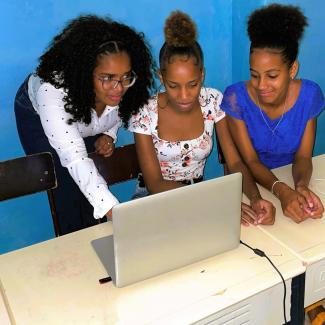
The Women in Tech project has already helped 30 young girls and 20 low-income women gain knowledge and confidence in ICT. By empowering these women, Helena hopes to decrease gender inequality, promote decent jobs, combat youth unemployment, and help the community overcome problems such as school dropout and the abuse of sexual assault against teenagers.
Despite its successes, the Women in Tech project still faces challenges. Convincing the target audience of the project’s importance and finding partners are just a few of the obstacles that Helena and her team have encountered. However, Helena remains determined to make a contribution to achieving the SDGs, specifically SDG 5, SDG 8, and SDG 10.