
Highlights of the 2022 programmatic results achieved per strategic priority (pillar) and financial overview - PEOPLE

Programmatic Results:
Vaccination

93% of 10-year-old girls were vaccinated against HPV, and the vaccination registry was reinforced with 44 more vaccinators and 80 registrars. The vaccination data registry was also strengthened with the DH IS2 system for regular vaccination and COVID-19. An Accelerated Plan for COVID-19 vaccination was developed, which included the introduction of the pediatric dose of Pfizer COVID.
Additionally, over 214,000 people were sensitized through community-based communication and sound strategies, and 230,000 surgical masks and 100,000 vaccination cards were distributed, with vaccination cold chain being reinforced.
Maternal and Child Health & Sexual and Reproductive Health
The intrapartum care guide was implemented in six hospitals, breastfeeding was promoted in 100% of health structures, including human milk donation, and 100% of health structures were restocked with over 7 million micronutrient tablets. Technical capacity in intrapartum care was improved in 18% of the country’s municipalities. In the field of SRH, 32 doctors and nurses were trained in the implementation of the safe birth checklist and in the management of postpartum haemorrhage.
Healthcare Services
Screenings for breast, cervical, and prostate cancers were carried out in six municipalities, benefiting 1,523 people (49% women). A Strategic Plan was prepared for the National Coordination Body of the Single Health Platform, and the regulatory instrument was produced for the operationalization of the Public Health Emergency Operations Centre. The Strategic Plan for Healthy Cities was validated, and a roadmap was developed to adapt the healthcare system to climate change recommendations from COP26. In addition, professionals from the human, animal, and environmental health sectors, as well as professionals in field epidemiology, were trained. The National Health Security Plan 2022-2026 was developed, and the “QUANDO” programme was implemented, with 22 doctors trained to implement the protocols in one of the neighbourhoods of Praia and São Vicente as pilots.
Nutrition
91,679 children (49% girls) aged 1-12 years were dewormed in compulsory basic education schools and
kindergartens, and 67,539 children aged 6-12 received iron supplements in compulsory basic education schools.
Cabo Verde was considered free of helminthiasis in preschool and primary school children, with a decrease in prevalence from 21% to 8% and from 7.6% to 0.9%, respectively.
HIV/AIDS
5,943 individuals (70.8% men) between the ages of 12 and 65 were informed and sensitized to the prevention of HIV/AIDS. Psychological support was provided to 387 pregnant and postpartum women living with HIV/AIDS, as well as to nine children exposed to the virus. Additionally, over half million male condoms were distributed throughout 100% of the country’s municipalities. The IV Strategic Plan for HIV/AIDS 2022-2026 was validated and disseminated, and the National Network of People Living with HIV (RPVVIH) and the ABRAÇO Association on the islands of São Vicente, Santo Antão, Santiago, Fogo, and São Nicolau were reinforced.
Alcohol and Drug prevention, Care, and Treatment
A Study on the Impact of the Increase in Tobacco Tax was carried out, and a guidance Manual for Smoking Cessation in healthcare was shared with primary and university students. Furthermore, a Therapeutic Community’s technical team (72% women) from São Vicente Island were trained to respond to the care and treatment of inpatients on an evidence-based. 28 community leaders (54% women) from Praia developed their capacities to become multiplier agents in prevention of alcohol and other drug use.
Prevention of Cybercrime
968 students and 85 teachers from high schools received cybercrime awareness notebooks and agendas developed to raise awareness against the threats of cybercrime. Additionally, 88 teachers (77% women) representatives of all municipalities in Cabo Verde were capacitated in preventing cybercrimes in the school context.
Primary and Secondary Education
A total of 190 teachers and 23 multidisciplinary teams were trained to attend children with special educational needs. Additionally, 200 school leaders had their administrative and financial management skills strengthened through training. The National Initiative for Education for Sustainable Development for 2030 was formulated, while 200 pre-school professionals in Santiago had their Portuguese language skills strengthened. Gender mainstreaming and human rights were incorporated into the Strategic Education Plan and over 100 parents were sensitized to the importance of committed and responsible parenthood.

Social Inclusion and Protection & Statistics
The Unified Social Registry (CSU - Cadastro Social Único) was updated to increase the number of registered eneficiaries from 78,000 to 90,000. A Social Charter was formulated, and a study on the Fiscal Space for Social Protection in Cabo Verde was carried out and approved. In terms of statistics, the Government of Cabo Verde published the Statistical Bulletin of the Social Protection System in Cabo Verde covering 2016-2020 and nearly 100 professionals and statistical information producers were trained in labour statistics and advances in the SDGs, allowing for more accurate and comprehensive data.
Over 40 women entrepreneurs from the informal markets of Sal Island were trained in micro-business management and financial education, with 18 of them formalizing their businesses. A digital application was developed to manage the “Mutual Fund”, which is now in use by the National Social Security Institute (CNPS). Additionally, a country profile on decent work was developed, and the Strategic Plan for the Rights of Persons with Disabilities 2022-2026 was formulated. Lastly, the National Care Plan for 2017-2019 was evaluated, providing the foundation for the National Care Plan 2023-2025.
Children and Adolescents
Two rooms were set up to provide safe care and medical-legal examinations for children who are victims of sexual violence. Furthermore, the Action Plan for the Prevention and Combating of Sexual Violence was disseminated throughout all islands to increase awareness and prevention of sexual violence. Additionally, 50 children and adolescents from the Black Panthers Association preschool were supported with nutrition, health, and education. The National Plan for Child and Adolescent Health 2023-2027 was elaborated to provide a framework for improving the health and well-being of children and adolescents in Cabo Verde. Lastly, 10,260 children, adolescents, parents, and caregivers benefited from mental health and psychosocial support services, contributing to their overall well-being.
Justice
205 justice system professionals were trained in forensic psychology, child interviewing techniques, and medical legal examinations, leading to more effective and sensitive handling of cases involving children. In addition, 1/3 of sexual crime cases against children and 2/3 of Family and Children’s Jurisdiction cases in Praia were concluded. Furthermore, 12,000 children and adults were provided access to a secure and accessible channel to report sexual exploitation and abuse. Finally, professionals at the Ministry of Public Prosecution were trained for speedy processing of cases in the Jurisdiction of Minors and Sexual Crimes Against Children.
People Pillar – Financial Overview
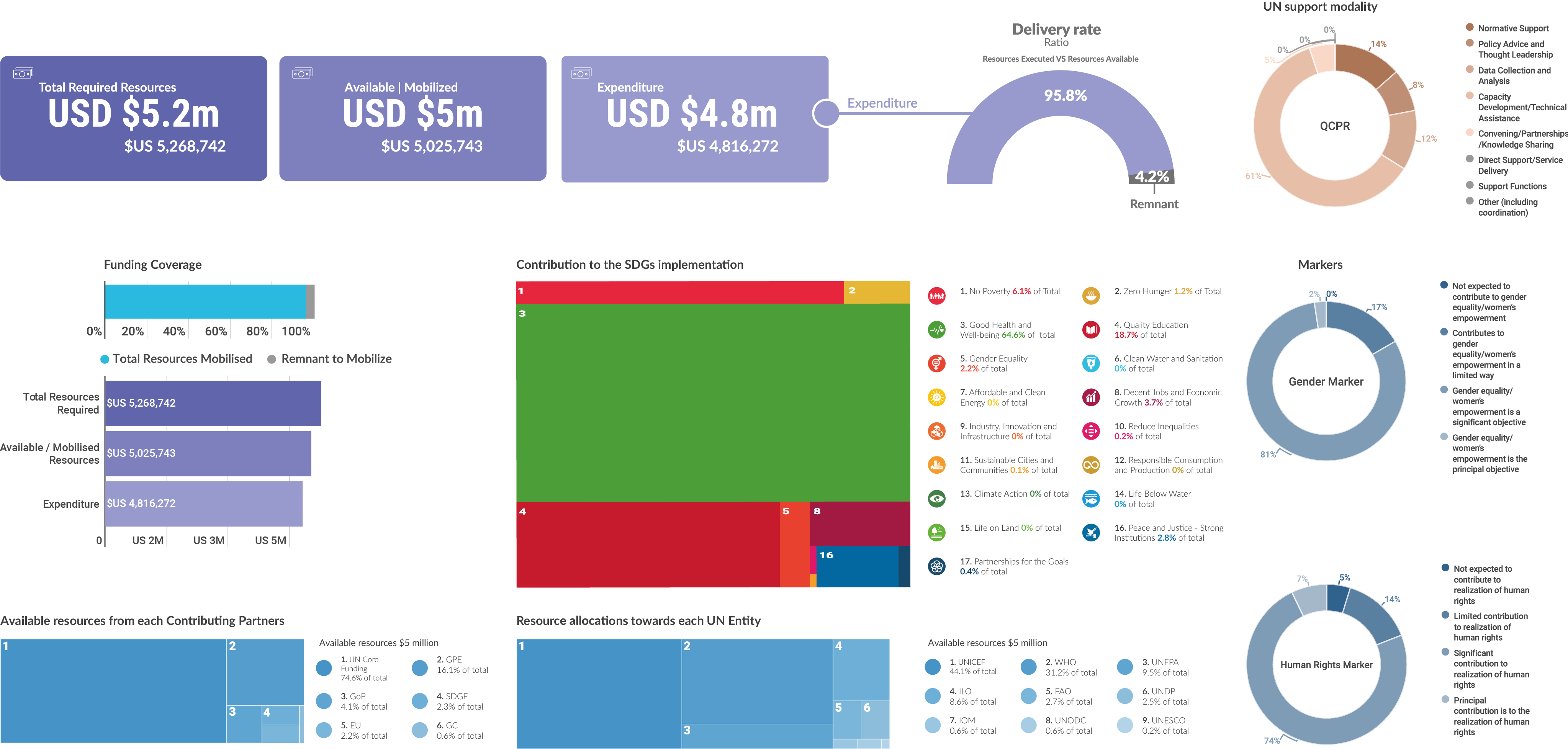
The People Pillar received an allocation of US$5 million, which accounted for 24.7% of the total funds available. This amount covered over 95% of the funds required for the Pillar, making it the Pillar with the highest implementation rate, around 95.8%.
Among the available funds, the largest portion, 64.6%, was allocated to advancing SDG 3 in Cabo Verde, followed by SDG 4 and SDG 1, with shares of 18.7% and 6.1%, respectively. The UN Core Fund was the main financial source, providing 74.6% of the funds, followed by GPE (16.1%), the Government of Portugal (4.1%), the Joint SDG Fund (2.3%), the European Union (2.2%), and the Government of Greece (0.6%).
of 10-year-old girls were vaccinated against HPV
benefited of screenings for breast, cervical, and prostate cancers were carried out in six municipalities
children (49% girls) aged 1-12 years were dewormed in compulsory basic education schools and
kindergartens, and 67,539 children aged 6-12 received iron supplements in compulsory basic education schools