

Highlights of the 2022 programmatic results achieved per strategic priority (pillar) and financial overview - PEACE

Programmatic Results:
National Statistics and Planning Systems
The Government elaborated, disseminated, and discussed a decentralization strategy with municipalities and civil society to prioritize territorial cohesion in the new national development strategy PEDS II 2022-2026. Additionally, an Economic Profile for each of the 9 inhabited islands of the country was created to help territorialize the new PEDS II. A Public Policy M&E Platform was established, which started to be operated linked to the State Budget, to enhance the monitoring of public finances and budget execution. The national statistical system’s capacities were strengthened to improve data production and better performance in governance statistics, using it to conduct the Pilot survey of the 4th Family Income and Expenditure Survey that identifies vulnerable and poor families to be the focus of social public policy.
Public Administration, Public Finances – Transparency
The technical and managerial capacities of public administration were strengthened through a new mobility regime, a national plan for training and qualification of civil servants, the Open Government 2023-2025 action plan, implementing the digitalisation process of the Central Registry Office, built the digital platform for institutional monitoring of the municipalities, and the draft law of the Municipal Status.
Gender Equality and Human Rights
The Government of Cabo Verde approved a national plan for gender equality, which began implementation with the support of the UN. Gender equality and human rights were integrated into all programmes of the new PEDS II, with indicators in the key logical frameworks. To ensure effective implementation new PEDS II cycle (2022-2026), 456 Ministry of Finance staff received training in gender-sensitive budgeting. The Gender Observatory was reactivated to strengthen monitoring and evaluation efforts.
Capacity building efforts were also made, with 195 professors and students from the University of Cabo Verde, as well as professionals from public institutions, civil society organizations, and school students receiving training and tools to address gender issues and human rights.
To fulfil international commitments for human rights, capacities of the Ministry of Labour and other institutions in the area of fundamental rights of workers was strengthened, ensuring that these issues were addressed at all levels of society.
Security and Justice
A law on the organization, competence, and functioning of judicial courts was revised, the money laundering law was revised, and the first national strategy on Preventing and Combating Money Laundering, Financing of Terrorism and Proliferation of Weapons of Mass Destruction was validated by the Government. The judiciary system adopted a full Ethical Commitment, based on the Principles of Judicial Conduct.
Efforts were also made to strengthen control of illicit trafficking at the airport through the Joint Airport Interdiction Task Force (JAITF) in Praia International Airport. This included the detection of high-risk passengers, drugs, and money laundering, as well as the capacity building of 26 staff in legal content and referral of people seeking justice. In addition, over 100 professionals in the areas of justice, child protection, and health received training in forensic clinical examinations and 35 investigators and prosecutors from Cabo Verde and other PALOP countries were capacitated on emerging threats in cybercrime.
To effectively address the impacts of the COVID-19 pandemic, a human security approach was integrated into the participatory local strategies of three very vulnerable urban communities. Three public spaces were designed using the “Participatory Methodology” to overcome the effects of the pandemic and ensure the safety and security of these communities. Community awareness sessions and specialized workshops on human security were held in the involved communities for 99 participants, 50 of whom were women.
Peace Pillar – Financial Overview
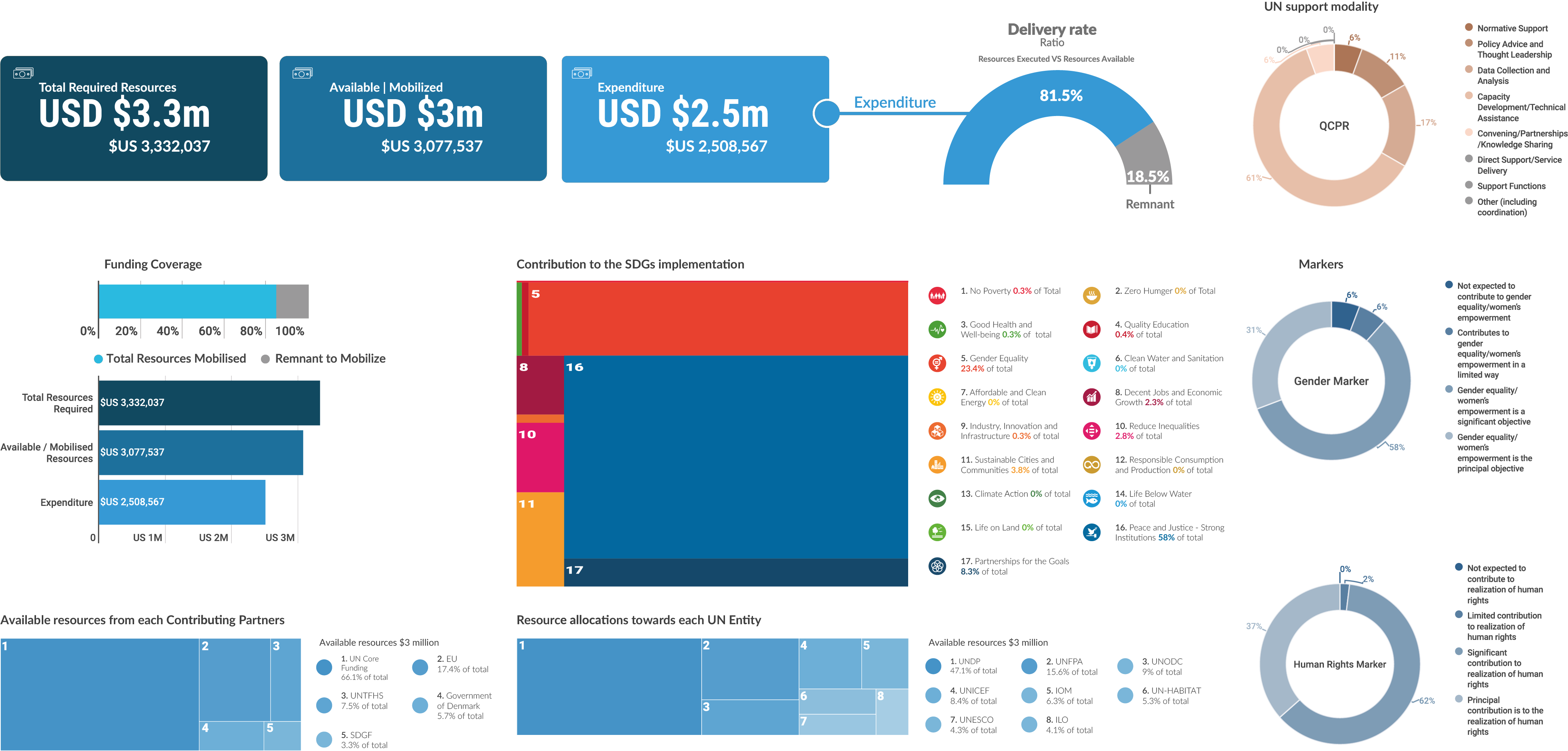
The Peace Pillar was allocated a budget of US$3 million, representing 15.1% of the total available funds. This amount covered 85.4% of the required budget for the pillar, with an implementation rate of 81.5%. Among the available funds, the majority percentage of 58% was allocated to advancing SDG 16 in Cabo Verde, followed by SDG 5 and SDG 17, with shares of 23.4% and 8.3%, respectively. The UN Core Funds were the primary financial source, representing two thirds of the funds with 66.1% contribution. The European Union followed with 17.4%, followed by the UN Trust Fund for Human Security (12.7%), the Joint SDG Fund (6.2%), the Government of Korea (2%), AECID (1.6%), the European Union (0.9%), and the Government of Cabo Verde (0.4%).
Ministry of Finance staff received training in gender-sensitive budgeting
professionals in the areas of justice, child protection, and health received training in forensic clinical examinations and 35 investigators and prosecutors from Cabo Verde and other PALOP countries were trained on emerging threats in cybercrime.